
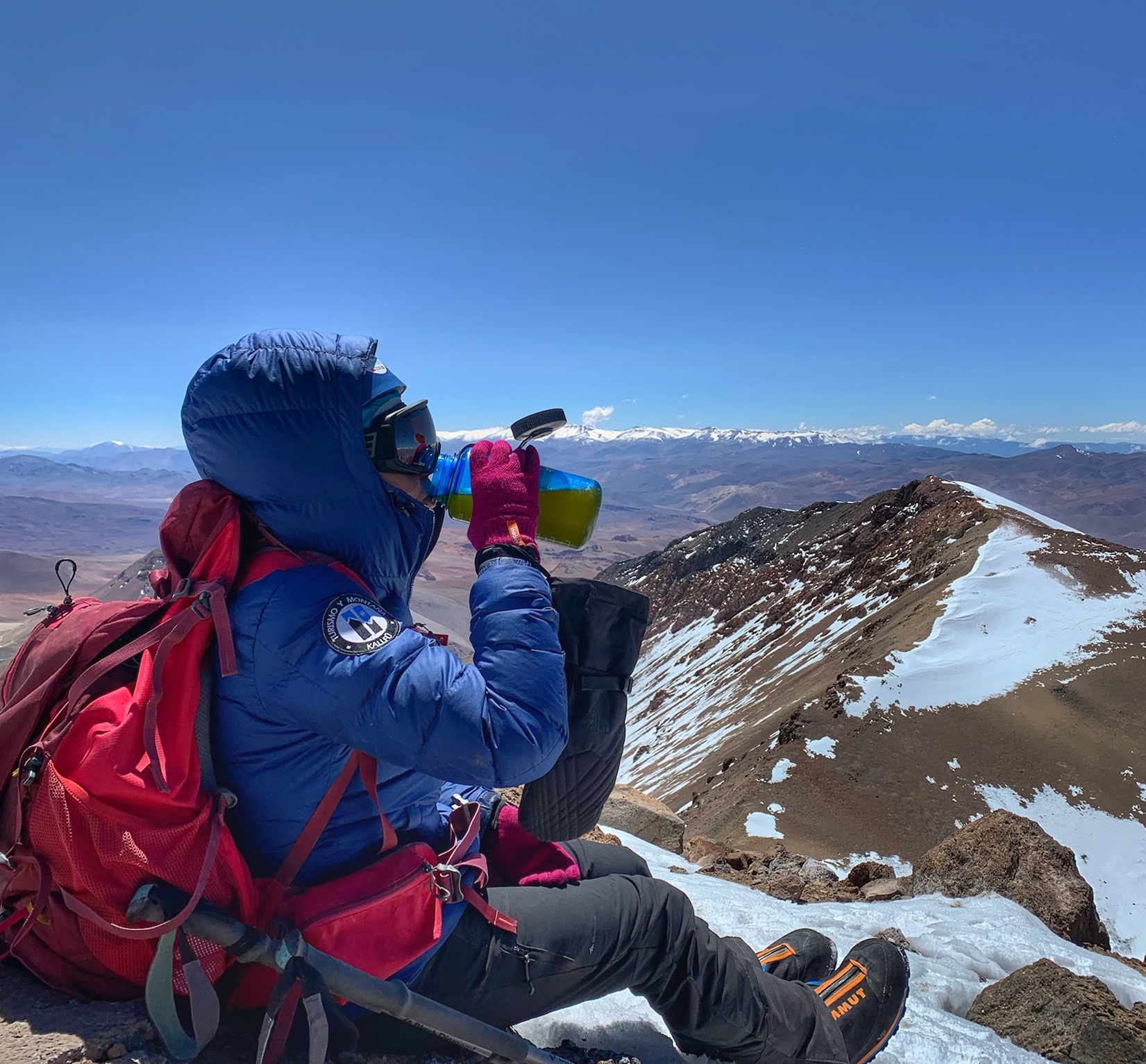

In general, most people know the importance of hydration when doing physical exercise, and high mountain climbing is no exception. But we must bear in mind that each sport has its own particularities and in our case, poor hydration can make it difficult or completely fail an attempt at climbing.
To understand the effects of body fluid loss during exercise, we must know that body water represents approximately 65% of body mass, and one of its main functions is to maintain a stable body temperature. The body loses water through sweat as a cooling mechanism in response to the heat generated by exercise. Water also transports nutrients to cells and metabolic waste from cells and is necessary for the proper functioning of organs and tissues. We could live weeks without food, but only a few days without water.
Exercise in a hot environment.
When the ambient temperature is higher than the skin temperature, the body gains heat, and body temperature can rise to dangerous levels. In this condition of high thermal stress, the only effective way to release heat is through the evaporation of sweat from the skin. In very humid environments, sweating contributes little to cooling the body because sweat evaporation is limited.
Because a large portion of the water lost in sweat comes from blood plasma, circulatory capacity is impaired as fluid loss occurs. Dehydration causes a decrease in plasma volume, blood flow, and sweat rate. As dehydration progresses, a marked decline in work performance is observed. This deterioration cannot be prevented solely by drinking fluids before exercise, by temporarily lowering skin temperature, or by applying water to the skin. The only effective method to attenuate the marked alterations in thermoregulatory and circulatory function is through fluid intake during exercise.
Dehydration during exercise in a cold environment.
In cold environments, fluid loss occurs through the airways. The decrease in temperature implies a decrease in the relative humidity of the air, therefore the air is drier. Cold air must be warmed before reaching the bronchi through breathing. The airways lose water and heat to humidify the inspired air volume. Significant amounts of water can be lost during exercise in cold environments.
Fatigue, headache, dizziness are some of the symptoms of dehydration, but BE CAREFUL! These symptoms are also symptoms of acute mountain sickness, so we must learn to identify them and for that we have the obligation and responsibility of not forgetting this item in our planning.
Dehydration during exercise at altitude.
Dehydration at altitude can occur due to a combination of low ambient humidity and physiological and behavioral factors. During the first few days at altitude, body fluid balance is altered. Fluid moves from the intravascular to the interstitial and intracellular spaces. The decrease in plasma volume causes the concentration of red blood cells to increase in blood plasma. Decreases in plasma volume of 8% and increases in hematocrit of 4% and hemoglobin of 10% have been observed after a one-week stay at 2.300 m (XNUMX ft). The higher the altitude, the greater the change in these values. These changes cause the oxygen content in arterial blood to increase significantly. During altitude acclimatization, diuresis occurs, and total body water is reduced. There is an increased risk of dehydration, especially during exercise in hot environments.
Because plasma volume is already reduced when exercise begins, dehydration will put greater stress on the circulatory system and thermal disorders will be more likely.
The air in mountainous regions is cold and dry, and a considerable amount of water can be lost through evaporation in the respiratory tract. This fluid loss usually causes mild dehydration and symptoms of dry lips, mouth, and throat. People often drink less fluid at altitude because they feel less thirsty due to the cold, hypoxia, and nausea from acute mountain sickness (puna), and sometimes due to a lack of drinking water. This particularly affects active people who experience high daily sweat loss. These people should monitor their weight and drink fluids frequently.
Effects of beverages ingested during exercise on body fluid balance.
At one time, there was a belief that athletes should not drink fluids during exercise, and I've recently heard from some mountaineers who argue that drinking little water during an ascent isn't a bad thing. As we already know, drinking fluids reduces the rise in body temperature and stress on the cardiovascular system, especially during exercise in a hot environment. The risk of low fluid intake is thermal disorders that can lead to death in an athlete. The risks of excessive fluid intake are gastrointestinal discomfort and a reduced gait during exercise associated with the physical difficulty of consuming a large volume of fluid. The decision about how much fluid to ingest should be based on the risks versus benefits. The benefits of adequate fluid intake improve performance and protect health.
Water.
During exercise, we usually replace less than half of the fluid lost through sweat. Unfortunately, because the thirst mechanism is inefficient, we must drink water at every break during our climbs, and we still won't be recovering what we lose through sweat.
Preventing dehydration can be achieved by following a pre-established water replacement regimen. During very long-duration activities, such as high-altitude mountaineering, every effort should be made to match fluid intake to fluid loss. This is especially difficult in these types of activities because the rate of gastric emptying is slower than the rate of fluid loss. Therefore, it is important to drink fluids before and after exercise.
Sport drinks.
Sports drinks contain glucose and minerals (electrolytes). Because sweat contains mostly water, it is more important to replace water than minerals. A small amount of glucose and electrolytes in the drink can increase fluid intake and absorption and be more effective at rehydration than plain water. Drinking plain water is rapidly absorbed in the intestine and dilutes the plasma sodium concentration. This stimulates urine production and decreases the thirst stimulus. A small amount of sodium in the drink helps maintain a high plasma sodium concentration and the thirst stimulus. Only in cases of extreme sweating should larger amounts of salt be added to food or drinks.
It was thought that adding carbohydrate to the drink would reduce gastric emptying time. We now know that solutions containing 8% or less carbohydrate have no negative effects on gastric emptying, especially when large volumes of liquid are consumed. The glucose in the drink increases the absorption of water and sodium in the intestine. The sodium enhances the flavor, encourages people to drink more water, and increases water absorption in the intestine.
Other drinks.
Beverages containing more than 8% carbohydrate, soft drinks, caffeinated beverages, and alcoholic beverages should be avoided during exercise.
Overhydration.
There is some evidence that hyperhydration in the days prior to activity may result in an increase in plasma volume and lower rectal temperature and pulse, and an increase in tolerance to prolonged exercise.
On the other hand, during very long-duration aerobic exercise (mountaineering, for example), excessive water consumption can only result in hyponatremia (water intoxication). This is a very dangerous condition characterized by symptoms such as headache, confusion, nausea, cramps, and seizures. This condition develops when large amounts of sodium are lost in sweat during prolonged exercise, and large amounts of fluids containing little sodium are ingested, causing the extracellular fluid to become excessively diluted. It is a serious condition that can cause death, but it rarely occurs in high mountains, since we often drink little water.
In summary:
- In high mountains, air humidity is lower and this, combined with physical exercise, makes us lose even more water, whether through sweat, breathing or urine.
- Dehydration can sometimes cause nausea, headaches and fatigue, which can mask or worsen the symptoms of acute mountain sickness (AMS), so it is important to stay hydrated.
- The Andean Institute of High Altitude Medicine, based in Mendoza, Argentina, recommends drinking an extra 1 to 1,5 liters a day. While the Wilderness Medical Society recommends between 3 to 4 liters a day, and that they also contain carbohydrates (isotonic powder drinks can be a good alternative).
- A simple way to check if you are well hydrated is by looking at the color of your urine, a light yellow tone is ideal.
- We must also pay attention to overhydration, since drinking too much water can dilute the body's sodium levels, which could cause weakness, confusion and even in some cases seizures, so it is important to maintain balance.
- Regarding how we get water, when planning your trip, don't forget to check if there is a water source near your base camp and if it is safe to drink or needs to be filtered or made potable. If you have any doubts, it is better to bring bottled water.
- For high altitude camps, in general, you have to melt snow/ice, water that does not contain minerals and that in some cases can cause stomach upsets, even diarrhea, so it is important to add mineral salts or add some product that allows you not to drink it pure. And also consider the necessary amount of gas and a pot exclusively for this purpose.
In the framework of our high mountain project "Project +6500 Los Andes", we spoke with Eric Ravest (@eric.ravest), First Aid and Mountain Medicine Instructor, who spoke to us about the importance of hydration in high mountain activities and the causes and effects of dehydration.
Relive the episode at the following link: https://youtu.be/urpmztP7T7A?si=Xl3qApKBfZfC3HK6
And remember, staying well hydrated, along with good nutrition and physical preparation, can make the difference between the success and failure of an expedition.

Bibliography: Book "Nutrition, Physiology and Exercise at Altitude", result of the International Course of the same name organized by ACHS and the University of Antofagasta, chapter "Hydration in Extreme Environments" by Professor Anita Rivera Brown.
